
The real bottleneck in 2026 data centre and fab builds is not capital
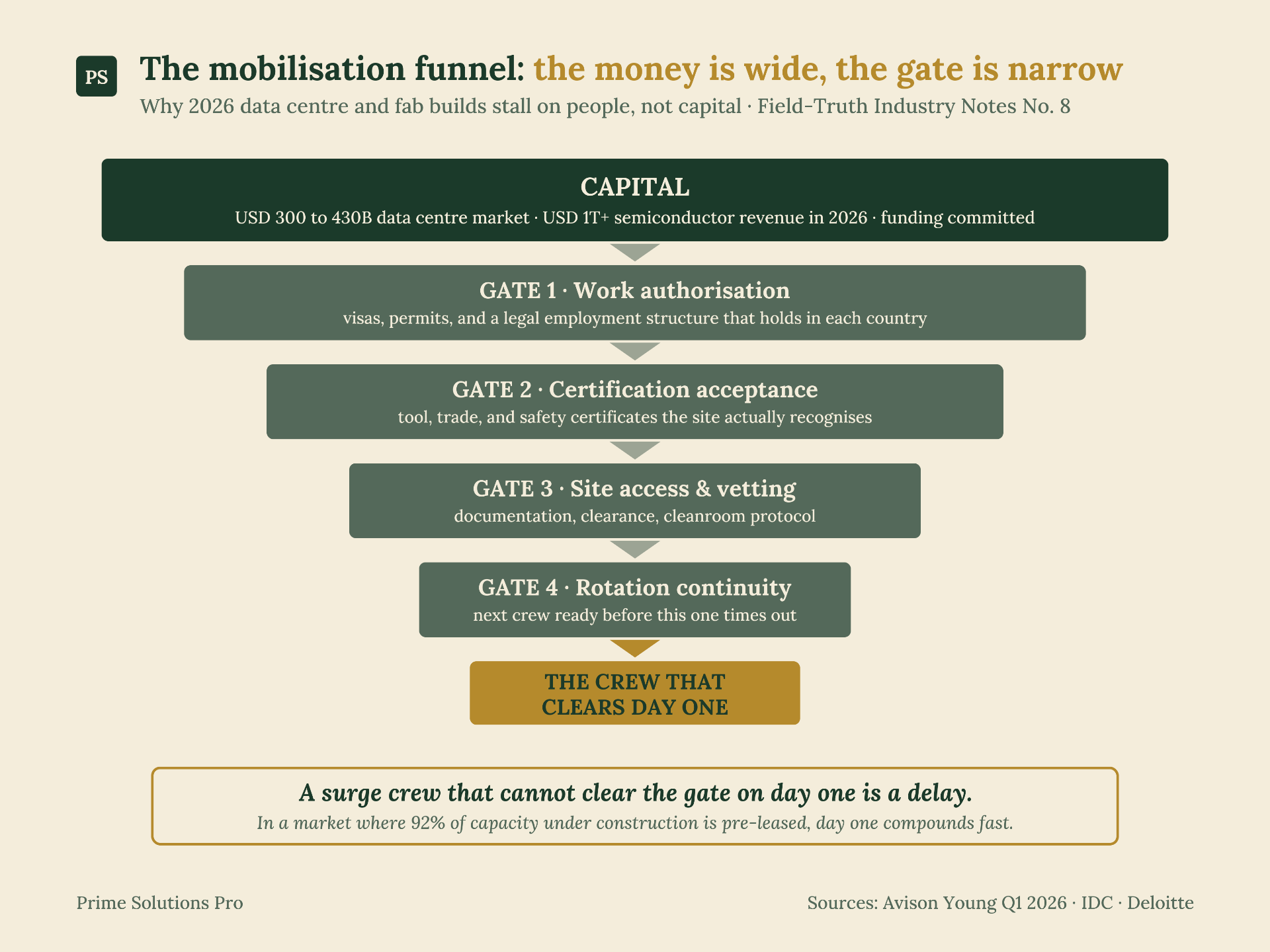
The global data centre market is USD 300–430 billion in 2026; semiconductor revenue passes USD 1 trillion. The money is there. The finite pool of people who can physically execute these builds — cleared, certified, and legally employed across jurisdictions — is not.
Ayleen Sadvakassova · EOR platform GTM for Energy mandates · 20 July 2026
The global data centre market is somewhere between USD 300 and 430 billion in 2026, depending on whose estimate you take, and forecast to more than double by the mid-2030s. Semiconductor revenues pass USD 1 trillion this year; IDC puts the 2026 number at USD 1.29 trillion. The money is there. The pool of people who can physically execute these builds — cleared, certified, and legally employed across multiple jurisdictions — is not. It is finite, and it does not scale as fast as a press release.
I spent seven years supporting the Taiwan market. This note is what that taught me, and why it now applies to every serious build from Taichung to Tempe to Tullamore.
Where the build cycle is concentrated
This is not a diffuse global trend. It is a concentrated surge in a handful of markets where the same execution gap keeps appearing.
The US holds roughly 43% of global data centre consumption, with US colocation inventory at about 29 GW as of Q1 2026. Around 92% of the roughly 35 GW under construction in North America is already pre-leased, per Avison Young. Read that again: the capacity is sold before it exists. Schedule slippage converts directly into financial and grid penalties.
Taiwan remains the discipline benchmark. TSMC and its supply chain turn tens of billions in fab capex into actual wafers by treating access, safety, and certification as the work itself — not paperwork after the fact.
Ireland and the Nordics are under pressure from hyperscaler expansion, grid constraints, and labour rigidity, inside a European programme where the EU Chips Act alone is mobilising more than EUR 43 billion in semiconductor-related investment.
Singapore and Johor have effectively become one combined execution zone, with a cross-border staffing and site-rules complexity that no generic HR supplier can manage.
Japan and India are the next major test cases. Both have multibillion-dollar programme envelopes stacking on top of existing digital infrastructure demand, and both will expose very quickly the difference between announcements and actual mobilisation depth.
Seller lesson: the market map is also your account map. Five execution zones, one repeating gap.
What a data centre and a fab actually are in 2026
A data centre is not a building anymore. It is a dependency. A fab is not a factory. It is national capability with a power bill attached.
That distinction changes what counts as a delivery risk. Between 2026 and 2030, global data centre capacity is expected to roughly double, toward 200 GW on Deloitte's numbers. And every gigawatt of it runs through the same scopes: critical power, cooling, electrical and MEP, cleanroom build, tool install and hook-up — all delivered by project-site surge crews who have to move fast and stay compliant simultaneously.
This is why the argument belongs in this series. These builds are won or lost on power: grid connections, critical power commissioning, energisation dates. The same buying logic as offshore wind and HVDC, and the exact same mobilisation machinery underneath it.
Where mobilisation breaks down
Most project failures in this space do not happen at the design stage. They happen at execution, inside a specific set of scopes: critical power and cooling install and commissioning, electrical and MEP delivery, fab construction, tool install and hook-up, cleanroom protocols and site safety, and country work authorisation and certificate acceptance.
Each scope has its own compliance layer, its own certification requirements, its own site-access logic. A crew cleared for one jurisdiction is not automatically cleared for another. A technician certified for one tool type is not automatically qualified for the next generation of equipment. These are not edge cases. They are the normal operating conditions of a cross-border, multi-site build in 2026.
I learned this the expensive way. In Taiwan, a crew arrived fully staffed but one key certificate was not accepted at gate clearance, and the whole mobilisation slipped by several days while the client rechecked jurisdictional requirements. A short delay on paper — but enough to compress the next work window and push up costs across the rotation.
A project can have sound engineering and still become a mobilisation problem within days. If the right crew cannot get on site, if the right certificate is not accepted, if the rotation is wrong, if the cleanroom protocol is not respected, the schedule punishes you immediately.
Seller lesson: the schedule does not care whose fault the gate was.
What execution readiness looks like
The operators winning on schedule in 2026 are not thinking in project language. They are thinking in three logics.
- Rotation logic: how long a crew can stay on site before fatigue, visa, or legal limits force a swap — with the next rotation ready before the current one ends.
- Access logic: the exact documentation, vetting, and site-specific safety requirements for each facility, known before mobilisation begins, not after.
- Compliance logic: which work authorisations, certifications, and legal employment structures each country requires, in place before a tool-install window opens.
Surge crews are the mechanism that holds this together. They are not a staffing convenience — they are the delivery mechanism for projects where the timeline is fixed and the tolerance for drift is close to zero. A surge crew that cannot clear the gate on day one is a delay, and in a market where tool-install windows are scheduled months ahead and cleanrooms run strict contamination controls, a day-one delay compounds fast.
Seller lesson: readiness is a noun you can inspect. Ask to see the rotation plan, not the org chart.
What buyers should stop doing
Stop describing what you need as global HR or generic labour support. That framing underprices the risk and attracts suppliers who cannot manage it. What you are actually buying is risk removal in hard jurisdictions: continuity, clearance, and an employment structure that does not break when the project crosses a border.
Stop buying day rate. Day rate optimises for the cheapest person available today. It does not optimise for the person who was on the last rotation, knows the site, knows the protocol, and picks up where the previous crew left off. In cleanroom and critical power environments, that continuity is a schedule dependency, not a preference.
Regular readers will recognise this argument. It is the seat-versus-risk problem from earlier in this series, now running through the largest construction programme on earth.
What sellers should stop doing
Stop leading with headcount. The question buyers are actually asking is: can you get cleared people, with the right certifications, through the right legal structure, onto the right site, inside the mobilisation window, and keep them there through the rotation cycle without a compliance gap?
Answer that with specifics — named jurisdictions, named certification types, named legal structures — and you are selling something real. Lead with a number and a rate card and you are not differentiating on the thing that matters. The market in 2026 is splitting on execution readiness. Operators who can demonstrate it with specifics are winning mandates. Operators who cannot are competing on price for work that will punish them on delivery.
Why this persists beyond 2026
The CHIPS Act, the EU Chips Act, the India Semiconductor Mission, and the equivalent programmes in Japan and Singapore are all creating sustained, multi-year demand for exactly this kind of specialised project-site workforce. Each programme is also creating its own compliance environment, its own certification requirements, its own local-content expectations.
The mobilisation model is not a workaround for a tight market. It is the permanent operating condition for anyone building or maintaining critical digital and semiconductor infrastructure across jurisdictions. The teams building that capability now — rotation management, cross-border compliance infrastructure, certified workforce pipelines — are building a structural advantage that will be very hard to replicate when the next wave of announcements becomes the next wave of FIDs.
The new bottleneck is not demand. It is delivery. And in 2026, delivery belongs to the teams that can mobilise people, not just promise capacity.
The field-truth
The new bottleneck is not demand. It is delivery. The steel does not self-assemble. The cleanroom does not staff itself. The power train does not commission itself. Every major build in this cycle will be won or lost at the mobilisation layer — before the first tool goes in, before the first panel is energised, before the first wafer moves.
If you are building or staffing in any of these five zones: where did your last mobilisation actually break — the certificate, the visa, or the rotation?
Get the Monday note in your inbox
Published every Monday on LinkedIn. Subscribe there and LinkedIn will deliver each new note straight to your inbox.