
You don't answer the RFP. You win it before it's written.
RFI, RFP, RFQ — three requests that tell you exactly how much room you have left. A field reading of the energy tender, from the seller's side of the table.
Ayleen Sadvakassova · EOR platform GTM for Energy mandates · 3 August 2026
It's Monday. Somewhere inside a European transmission operator, a procurement lead is closing a vendor shortlist for a nine-figure workforce programme. Four suppliers made the list. Three of them will spend the next six weeks writing a proposal they have already lost. They just haven't been told yet.
I've been one of those three. I've also been the one who was never really in a fight, because the requirements had been shaped months before the document went out. The gap between those two seats is the whole game — and almost none of it happens in the proposal.
The request-for-proposal is the most misread document in enterprise energy sales. Sellers treat it as the starting gun. It's closer to a receipt: a record of a decision that has already started forming. If you only show up when it lands in your inbox, you're not competing. You're auditing someone else's choice.
So this week I turned how I read a tender into a field guide — four cards a new account executive can keep open on a live deal. Below is the thinking behind them.
The three requests, and what they actually tell you
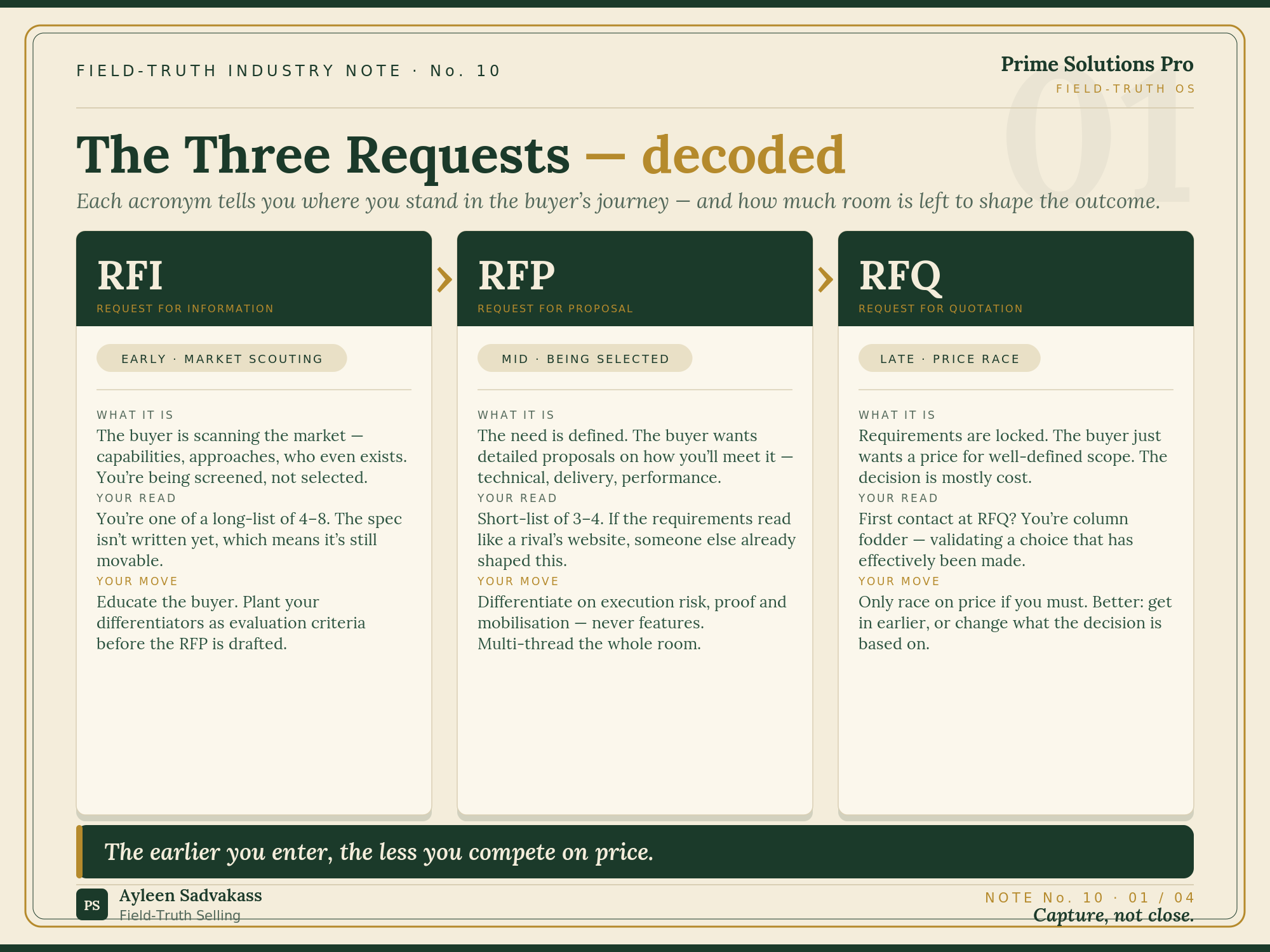
A Request for Information (RFI), a Request for Proposal (RFP), and a Request for Quotation (RFQ) are not three formats. They are three positions on a timeline — and the one that lands in your inbox tells you, before you read a single line, how much room you have left.
An RFI means the buyer is still scanning the market: who exists, what's possible, roughly what it costs. You are being screened, not selected — one of a long-list of four to eight — and, crucially, the specification isn't written yet. Which means it's still movable.
An RFP means the need is defined and the buyer wants detailed proposals on how you'll meet it. You're on a shortlist of three or four. If the requirements read like a competitor's website, someone else has already been in the room.
An RFQ means the requirements are locked and the buyer just wants a price. If your first contact with the account is the RFQ, you are column fodder — a quote that makes someone else's pre-made decision look competitively tested.
Same buyer. Three very different amounts of oxygen.
Seller lesson: the earlier you enter, the less you compete on price.
An RFI is an audition. An RFP is the final.
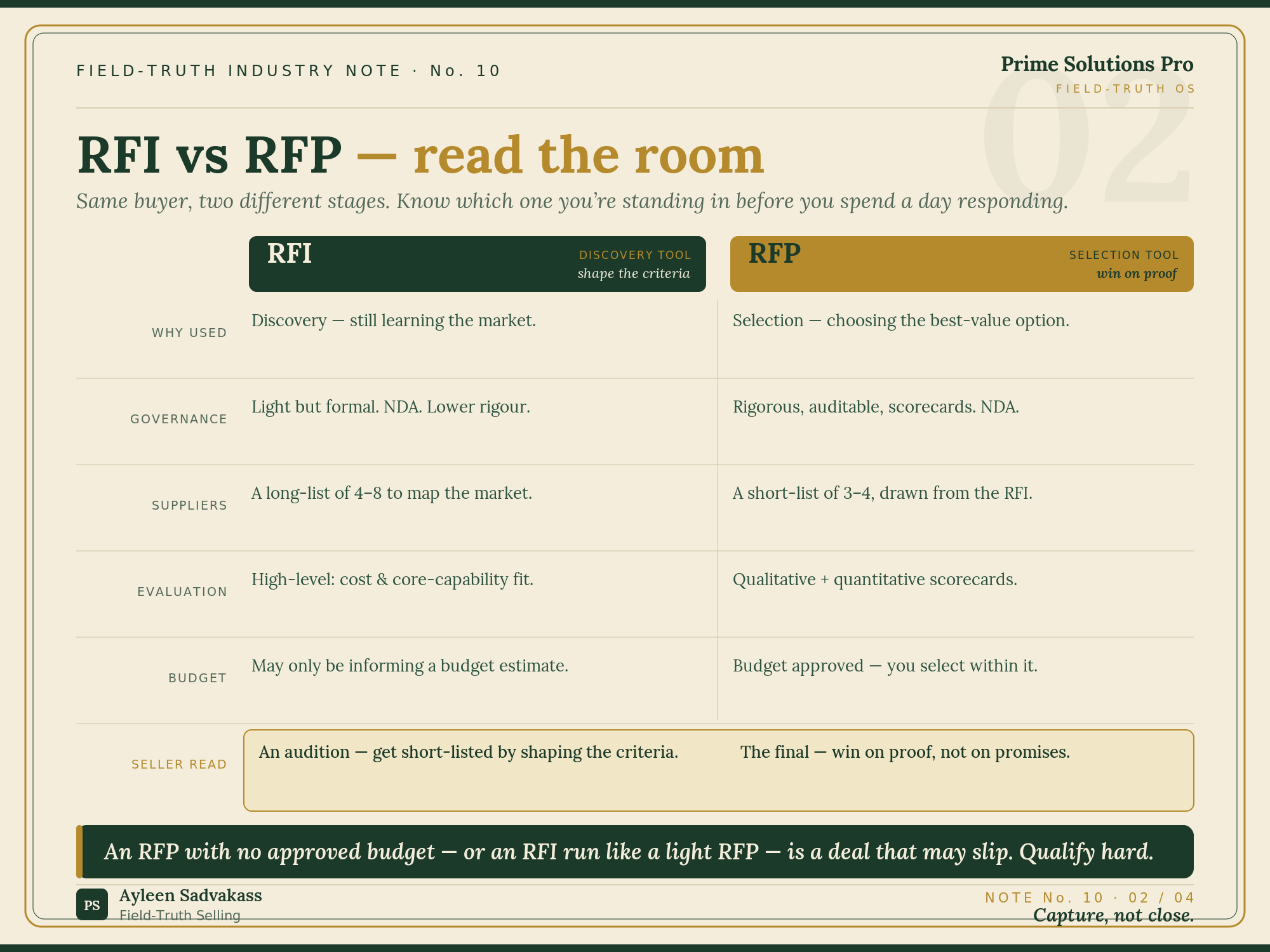
The two you'll actually spend time on are the RFI and the RFP, and sellers routinely confuse them — treating a discovery exercise like a bid, or a bid like a discovery exercise.
An RFI is a discovery tool: light but formal, an NDA, a long-list, high-level evaluation of cost and core-capability fit. Its budget may still be an estimate. Its purpose, for you, is to get shortlisted by shaping the criteria the buyer will later score against.
An RFP is a selection tool: rigorous, auditable, scorecards, a shortlist drawn straight from the RFI. The budget should be approved and the aim is to select within it. Its purpose, for you, is to win on proof, not on promises.
The watch-out is the tell that saves you weeks: an RFP issued with no approved budget, or an RFI being run like a light-touch RFP, is a deal that may slip. That's not a document quirk. It's a qualification signal. Read it and decide how much of your quarter this deserves.
Seller lesson: know which stage you're standing in before you spend a day responding.
The deal I "lost" in 2019 and rewrote in 2021
(Anonymised, figures rounded.) In 2019, a global operator pre-selected a dozen contracting providers in Singapore for a fabrication scope. On paper, that shortlist closed the door on high completion; in reality, it opened a room.
For two years I stayed in that room — the kind of contact where you're the person they call to sanity-check a commissioning plan that has nothing to do with a purchase.
By 2021, when that operator realized they needed a full exclusive offshore commissioning and installation tender, I wasn't queueing up to answer an RFP. I was in the room while the requirements were being written. When the RFP finally published, it read like our operating model — not because we wrote it, but because we'd helped the buyer name the risk, and the solution had our fingerprints on it. The same pattern shows up in the proof cases.
Seller lesson: you don't win the tender in the proposal. You win it in the relationship that shaped the specification.
Reading the RFP to win it
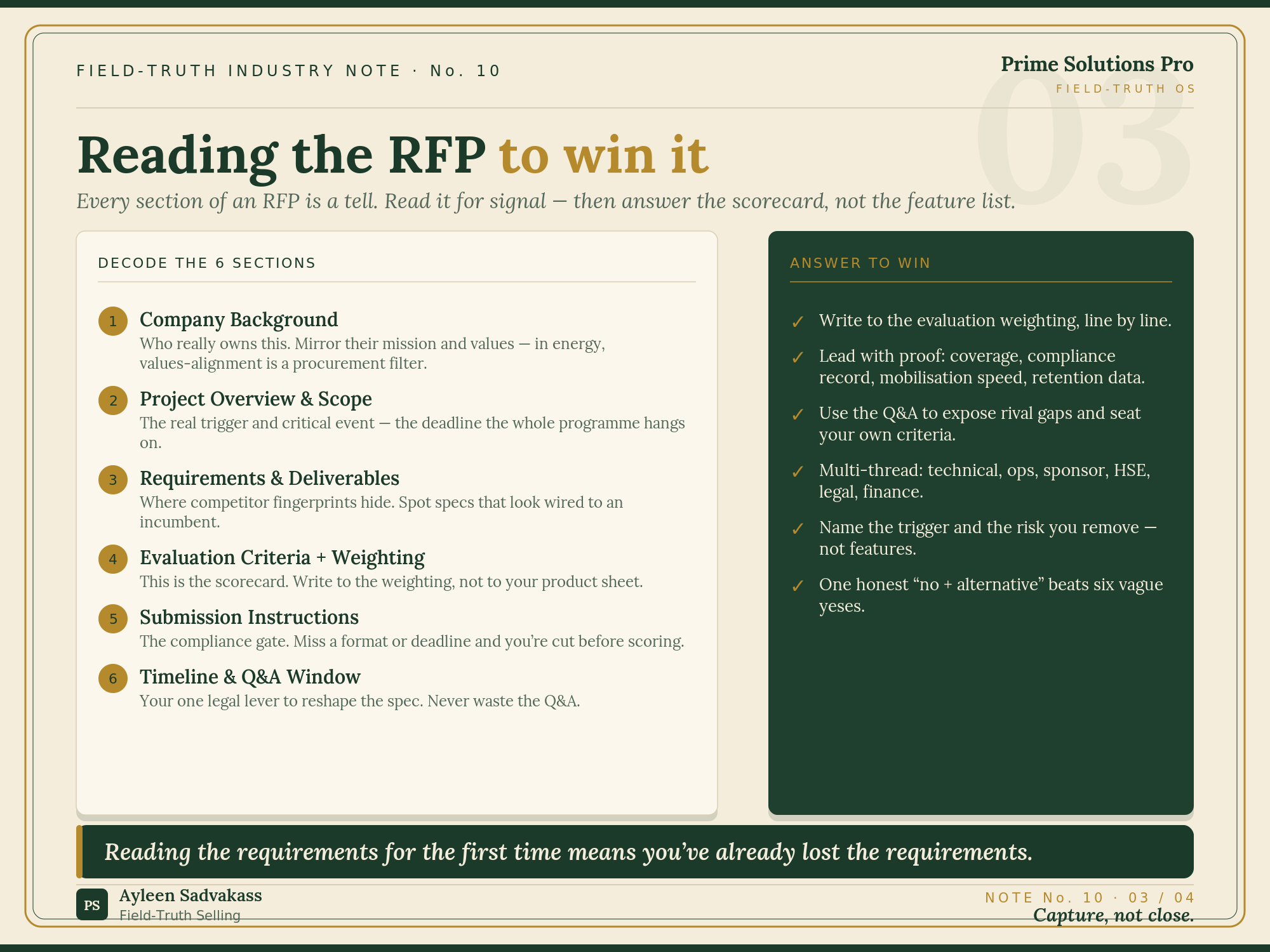
Say you did all that and the RFP still lands. Good. Now read it as a tell, not a task. Every section is signalling something.
Company background tells you whose mission and values you must mirror — and in energy, values-alignment is a genuine procurement filter, not a nicety. Project scope names the real trigger: the critical event the whole programme hangs on. Requirements and deliverables are where competitor fingerprints hide — spot the spec that looks quietly wired to an incumbent. Evaluation criteria and their weighting are the scorecard; write to the weighting, not to your product sheet. Submission instructions are the compliance gate — miss a format or a deadline and you're cut before anyone scores your thinking. And the timeline's Q&A window is your one legal lever to reshape the spec in the open. Never waste it.
Answer with proof, not adjectives: coverage, compliance record, mobilisation speed, retention data. Multi-thread the room — technical, operations, sponsor, HSE, legal, finance — because a single-threaded bid dies the day your one contact changes jobs. And name the trigger and the risk you remove, not the features. One honest "no, but here's the better path" beats six vague yeses.
Seller lesson: write to the scorecard, not the feature list.
The 90-day clock
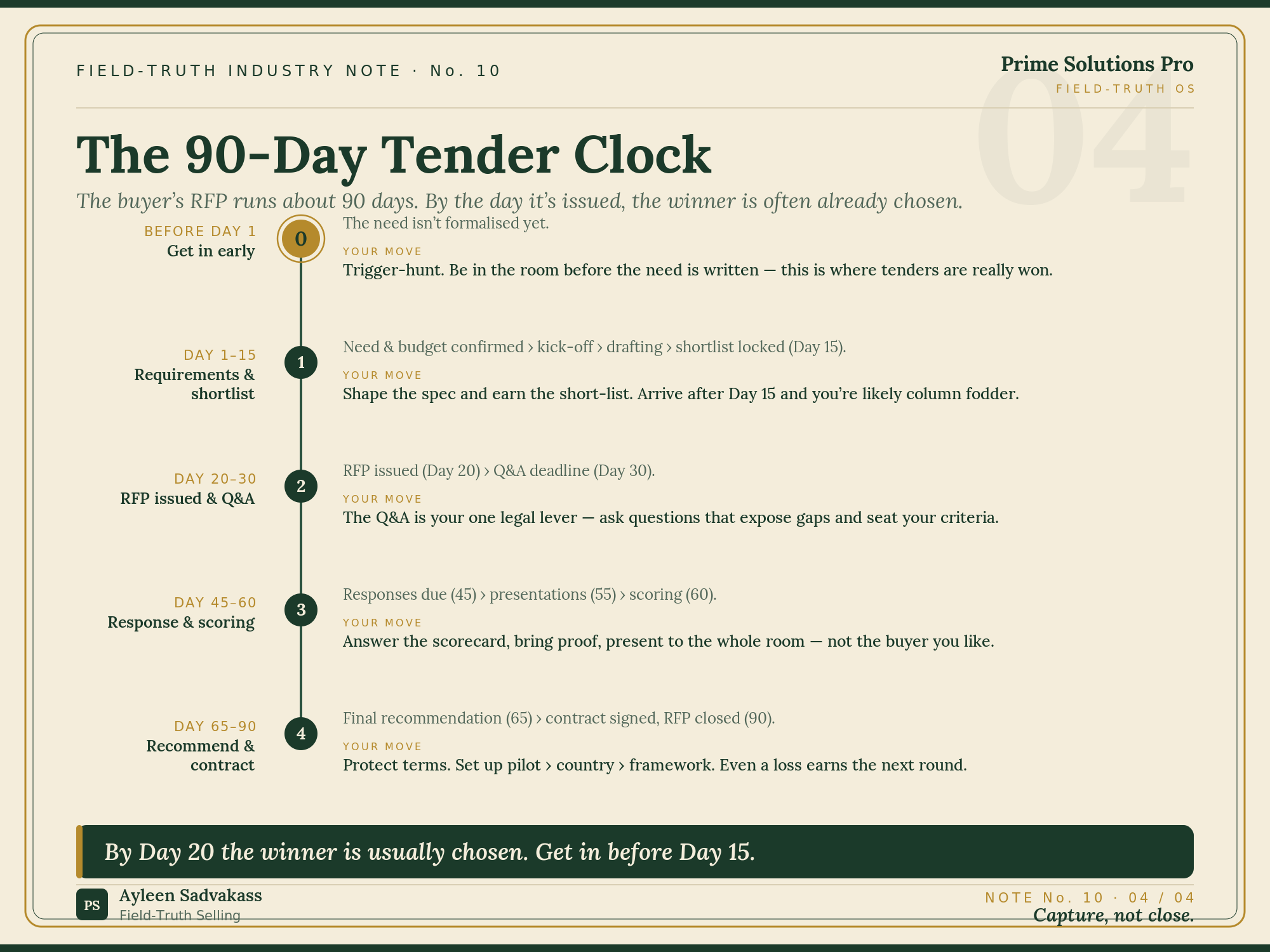
Put it on a calendar and the whole thing becomes obvious. A typical RFP runs about 90 days. The business need and budget are confirmed around Day 1. Kick-off, drafting, and the shortlist all happen inside the first two weeks — the shortlist is usually locked by Day 15. The RFP itself doesn't issue until Day 20.
Read that again. By the time the document you're racing to answer is public, the field has already been cut, the criteria already set, and — often — the preferred supplier already forming in the evaluators' heads. Responses, presentations, and scoring fill Days 45 to 60. The contract signs around Day 90.
The proposal phase is real. It's just not where the deal is decided. It's where a decision that started forming on Day 12 gets its paperwork.
Seller lesson: by Day 20 the winner is usually chosen. Get in before Day 15.
Why this bites harder in energy than anywhere else
In most SaaS, a lost bid costs the buyer a switch and some change-management pain. In energy, a failed mobilisation can stall a programme measured in gigawatts and billions — so the buyer isn't really purchasing seats or software. They're purchasing the removal of execution risk across a twenty-five-person buying group and a fistful of jurisdictions.
Execution risk isn't decided in a proposal. It's decided upstream, in the org chart, in whether the people scoping the programme already trust that you can move 400 people across seven countries without a single visa or compliance failure. That trust is either built before Day 1 or it isn't there to buy.
Which is the whole thesis of this publication, said one more way: energy tenders are won on risk, not rate — years before they're published.
So before you write another word of a proposal, ask one question: when this RFP was being drafted, whose operating model was in the room? If the answer isn't yours, you're not bidding. You're validating someone else's pick — and you should either change the basis of the decision or spend the week on a deal you can actually win.
Get the Monday note in your inbox
Published every Monday on LinkedIn. Subscribe there and LinkedIn will deliver each new note straight to your inbox.