
Is the per-seat SaaS model for Employer of Record dying?
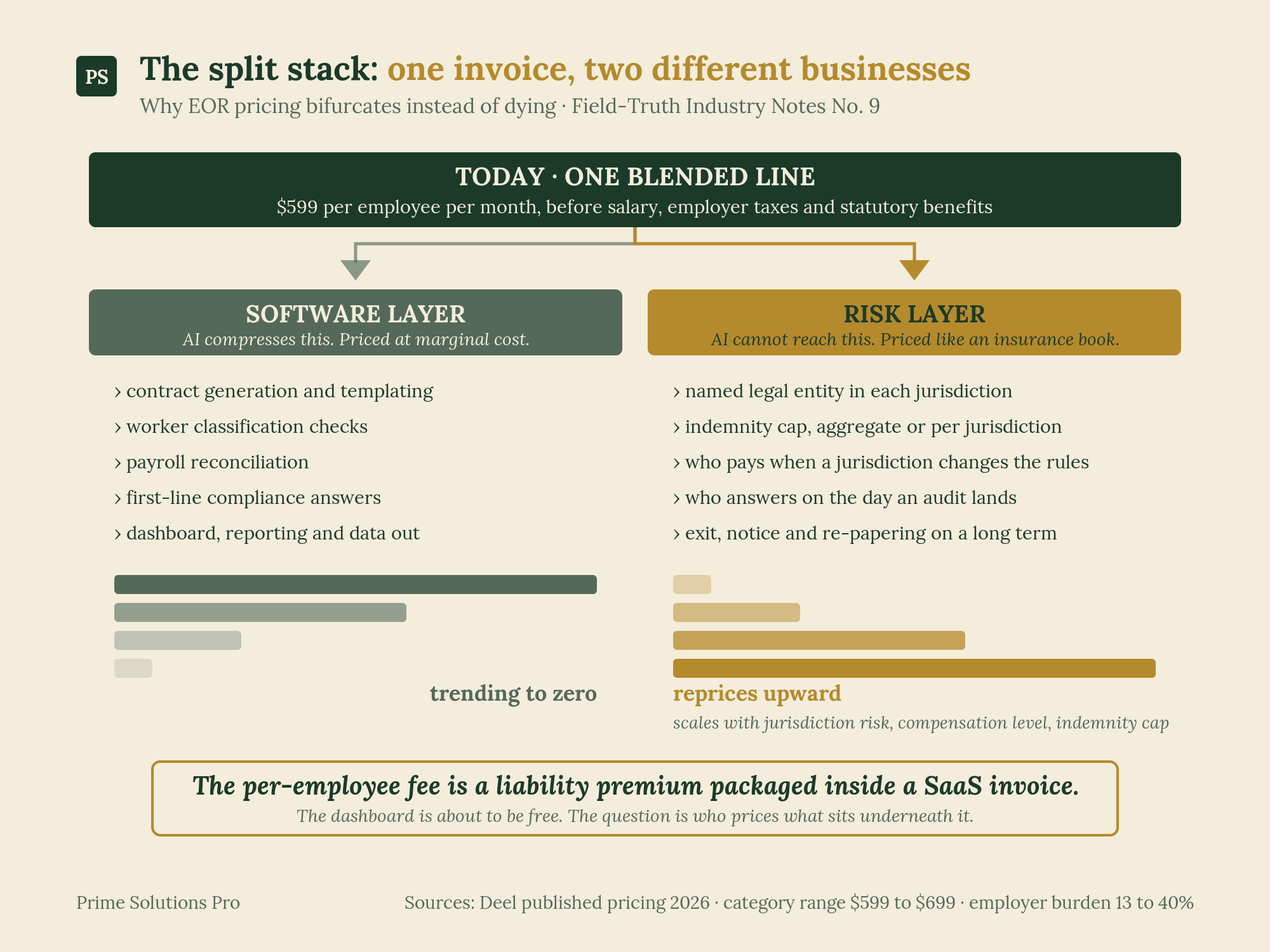
The per-seat model for Employer of Record services is not dying. It is bifurcating. The software half is heading toward zero; the liability half is repricing upward. Most providers are not ready for that distinction — and neither are their buyers.
Ayleen Sadvakassova · EOR platform GTM for Energy mandates · 27 July 2026
Marcelo Lebre, co-founder and president of Remote, posted recently that nobody knows where software pricing lands: per-seat is on its way out and usage-based pricing is coming, because AI now lets companies build internal tools instead of buying another seat.
He is right, and the honesty is worth noting given what Remote sells. But the argument is about software pricing — and EOR is only half a software product.
What the $599 actually buys
Deel prices Employer of Record at $599 per employee per month. Across the major providers the platform fee clusters between roughly $599 and $699, with outliers at both ends. None of those numbers include salary, employer taxes or statutory benefits, which add somewhere between 13 and 40 per cent on gross depending on jurisdiction. The whole industry is priced by the head.
That fee is not a login. It never was.
When you pay $599 per employee per month, you are paying for a legal entity in a jurisdiction where you have no standing. You are paying for a company whose name goes on the employment contract, whose balance sheet absorbs a wrongful-termination claim in France, and whose principal answers when the labour regulator calls.
The per-employee fee is a liability premium packaged inside a SaaS invoice.
Once you see it that way, the pricing logic changes completely.
Why AI splits the model rather than ending it
AI is genuinely compressing the marginal cost of the software layer inside EOR: contract generation, worker classification checks, payroll reconciliation, first-line compliance answers. A competent payroll manager with good tooling can now do things that used to require a platform. That erosion is real and it will hit the software half of every EOR product hard.
What AI cannot reach is the other half. No one prompts their way to a legal entity in Vietnam. No model stands as employer of record on a Taiwanese offshore contract, carries the indemnity, or takes the call from a regulator. That function requires a human organization with legal standing, balance-sheet capacity, and accountability in a named jurisdiction.
So the per-seat model does not gradually migrate to usage pricing. It splits: a software layer trending toward zero, and a risk layer that behaves like an insurance book — scaling with jurisdiction risk, compensation level, and indemnity cap.
Seller lesson: you are not defending a price. You are separating an invoice.
Nobody in those rooms was pricing logins
I have priced EOR on the risk side across a number of regional and global tenders: energy operators and developers, EPC contractors, transmission system operators. Different buyers, different countries, different asset classes. Not one of them priced logins.
That is the part I want to be precise about, because it is easy to dismiss a single mandate as an outlier. This was not one unusual room. Across every serious tender I have worked on, the commercial conversation ran inside the risk layer — and it ran there for reasons specific to each buyer type.
Operators and developers hold the asset for decades. Employment liability incurred during construction does not leave with the contractor; it sits on a balance sheet they will still own in 2045. EPC contractors exist to pass risk down the chain in defined packages — they need to know exactly where your liability starts and stops, because anything ambiguous ends up back with them at the worst possible moment. TSOs are regulated and publicly scrutinised; the audit trail is not administrative overhead, it is the deliverable. A procurement decision they cannot defend in writing is a procurement decision they cannot make.
Three different reasons. Same conclusion: the price follows the risk transferred, not the headcount on a spreadsheet.
What the conversation actually covered — and what the same conversation covers everywhere else (example, based on an eight-year EOR workforce programme across seven jurisdictions):
- Who carries employment risk in each jurisdiction, by name. Not "we have global coverage." Which registered entity, in which country, on which contract, for which work package.
- How the crew mobilises and demobilises against the programme timeline. Seven countries, eight years, and a construction sequence that moves people in campaigns rather than in monthly headcount increments. Every mobilisation window is a compliance event and a schedule risk at the same time.
- Who stands behind the compliance chain when an audit lands. Not whether an audit is likely — what happens on the day one arrives, who responds, whose balance sheet absorbs the finding, and whether the programme stops while it is resolved.
- What happens if the provider exits a jurisdiction mid-programme. On an eight-year term this is not hypothetical. It is a standard question, and most platform contracts answer it badly.
These teams are excellent at the four questions above and have almost nothing to ask about the platform. Feature comparison rarely appears. Seat count rarely appears. The commercial conversation runs entirely inside the risk layer — exactly the layer per-seat pricing renders invisible. These tenders are not decided on the demo.
Seller lesson: when the buyer is sophisticated, they do not ask you about the software. If your quote only prices the software, you have already been read as a tool.
Three questions that move a rate conversation into a risk conversation
The most common objection into this market is some version of "$599 is expensive, another provider quoted us $400." Arguing the rate loses. Changing the axis works. Three questions, in this order.
- Which jurisdiction is this role based in, and which legal entity will appear on the employment contract? This forces the buyer to notice that the two quotes may not be covering the same thing, and it surfaces immediately whether your competitor is operating through a partner entity rather than its own.
- If a wrongful-termination or misclassification claim lands in that country, whose balance sheet absorbs it, and up to what limit? This moves the conversation from a monthly rate to a cap. Caps are comparable. Rates without caps are not.
- Has your legal team reviewed whether the indemnity cap in the current contract is aggregate or per jurisdiction? Most buyers have not asked this. When they go and check, you have changed who they are comparing you against.
None of these three questions mentions your product. That is the point.
Three ways the invoice actually changes
The transition away from per-seat is already visible in how a few providers are positioning. It moves in three directions, each with a readiness signal attached.
Embedded finance. Providers drop the platform fee toward zero and monetize the money in motion instead: FX spread, early payment, benefits margin. The pitch becomes "we do not charge per employee, we make money moving your payroll." Several large players are already partially inside this model. This deal is ready for it when the buyer's payroll volume is large and predictable, the jurisdictions are low-risk, and the person pushing back on your price sits in finance rather than in legal.
Per mobilization, not per head. Offshore wind and HVDC projects do not hire in tidy monthly headcount increments. They mobilize: a crew activated for a campaign, moved across jurisdictions, certified, deployed, demobilized. Pricing that as a per-seat monthly line is a category error. This deal is ready for it when the scope arrives as work packages rather than roles, when the buyer's own schedule has campaign windows in it, and when someone on their side uses the word "demobilization" before you do.
Outcome and indemnity tiers. Selling a feature list competes on rate. Selling a compliance guarantee with a defined indemnity cap competes on coverage, the way an insurance product does. Providers that make this transition stop being compared to payroll software and start being compared to specialist legal and insurance providers. This deal is ready for it when legal or risk joins the call, when the buyer asks for your entity register unprompted, or when the words "cap," "carve-out" or "step-in" appear in their questions.
The unnamed winner, and what it still has to defend
Notice that the second of those three models is not a forecast. The specialist workforce providers in energy have priced per mobilization for decades, because the projects gave them no other option. They carry their own entities in the hard jurisdictions, they hold the certification and rotation logic, and they already answer the audit question with a name rather than a brand.
If that is your business, the bifurcation moves in your favour and you should stop apologizing for the invoice. Your structure was never the legacy option. It was the risk-priced option, sold badly.
But two things need defending, and neither of them is the rate. First, the software layer — which you will not win and should stop trying to. Buyer-facing visibility, self-serve onboarding, real-time cost modeling, clean data out: the SaaS platforms are genuinely better at this and the gap is widening. Losing on interface while winning on liability is survivable only if the liability is legible in the quote. Usually it is not. Second, the mid-risk middle, where the SaaS players are actually catching up — not Vietnam or Taiwan, but Germany, Poland, the Netherlands, the UK. Predictable jurisdictions, standard roles, moderate exposure. That is where a platform can now carry real coverage at a lower operating cost than a specialist, and where the specialist's premium starts to look like inertia rather than risk.
Seller lesson: the specialist advantage is real, and it is narrower than you think. Defend the jurisdictions where the entity is genuinely hard to hold, and price the rest honestly.
What happens if your provider is acquired
This one belongs to the buyers, and it is the question nobody asks in a pre-qualification meeting. Once the software layer is commoditized, scale and cost efficiency are the only levers a platform has left. Cost programmes that follow an acquisition or a restructuring target compliance and in-country headcount early, because that layer is the most expensive to maintain and the least visible to the customer.
That layer is the thing you are actually buying. If your provider changes hands mid-programme, the software will get better and the answer time on a Vietnamese labour query will get worse. The dashboard is not what fails you. The person who used to know the answer is.
What cannot be bought is specialist compliance and mobilization capability in a hard jurisdiction. Nobody acquires their way to being trusted as employer of record on a Taiwanese offshore programme. That trust is built one mandate at a time, under regulatory scrutiny — and it is exactly what reprices upward as the software layer goes to zero.
The buyer's audit for the risk layer
If you are reviewing EOR proposals inside a tender, five questions separate the providers who can carry the liability from the providers who are reselling it.
- Name the legal entity in each deployment jurisdiction — own entity, partner entity, or none. Ask for the register. A provider carrying its own entity in seven countries and a provider subcontracting six of them are not the same commercial object, whatever the monthly rate says.
- Is the indemnity cap aggregate or per jurisdiction? An aggregate cap across a multi-country programme is a single pot the first serious finding empties. Per-jurisdiction caps cost more and mean something.
- What happens on regulatory change? Ask specifically who absorbs the cost when a jurisdiction changes its classification rules, localization quotas or permit regime mid-contract. Silence here means you absorb it.
- What is the exit provision if the provider leaves the jurisdiction? On a multi-year programme, get the notice period, the transfer obligation, and who pays for the re-papering of every employment contract.
- Who responds when an audit lands, and does the programme continue while it runs? You are buying continuity as much as compliance. A provider who cannot describe their audit-response process has not been through one.
Three red flags in the room
The provider cannot name the local entity — if the answer to "which entity employs this person in Norway" is a brand name rather than a registered company, the employment relationship is running through someone else's balance sheet and you have not been told whose. The indemnity clause references an aggregate cap with no per-jurisdiction breakdown — the single most common way liability is sold and not carried. And there is no mention of regulatory-change handling anywhere in the contract — not a drafting oversight, but a statement about who is expected to absorb it.
What it looks like when it goes wrong
The liability argument stays theoretical until it isn't. Enforcement has tightened: tax and labour authorities are sharing data and audit volumes are rising. When a regulator opens a file, it contacts the named employer. If that named employer has no in-country principal, no substantive registered employment relationship, and a contract that points back to a platform headquartered elsewhere, the enquiry does not stop there. Authorities routinely look through to the company directing day-to-day operations, and a single audit covering several misclassified workers can produce six- or seven-figure exposure in back wages, damages and penalties.
The liability does not disappear. It transfers to the buyer. That is what you are buying down for $599 a month — and it is why the number was never about software.
RFP language that selects on risk capacity
If the insight cannot be written into a procurement document, it stays an opinion. Three requirements you can paste into a brief:
- "Provide a schedule of named legal entities maintained by the bidder in each proposed deployment jurisdiction, stating ownership status (wholly owned, joint venture, or partner arrangement)."
- "State the indemnity cap applicable to each deployment jurisdiction separately, and confirm whether caps are aggregate across the programme or held per jurisdiction."
- "Describe the bidder's obligations and cost allocation in the event of a material regulatory change, and the notice, transfer and re-papering provisions in the event the bidder ceases operations in a deployment jurisdiction during the contract term."
Three lines. They will re-sort your shortlist.
When the split becomes visible
You will not see a press release. You will see it at the next contract renewal, in whether the provider holds the rate or restructures it. You will see it in how providers respond to indemnity questions: the ones repricing the risk layer answer with numbers, the ones that are not answer with reassurance. And you will see it in which players quietly exit hard jurisdictions or raise minimums on high-risk mandates. If you are mid-programme today, this is a renewal conversation, not an emergency. If you are drafting a tender this quarter, it is already the tender.
Two exits
If you sell EOR: stop defending the blended number. Split your own invoice before the market splits it for you, so the software line can go to zero without taking your margin with it. The providers who survive this will be the ones who can price the risk layer cleanly — in named jurisdictions, with defined indemnity limits and explicit guarantees. That is a different conversation from comparing monthly per-employee rates across a shortlist, and it is one your current pricing page probably cannot start.
If you buy EOR: run the five-point audit above on the proposals already sitting on your desk. Not at renewal — this week. The gap between the providers who can carry the liability and the providers who are reselling it is not visible in the monthly rate, and the monthly rate is the only thing most shortlists compare. On a twenty-five-person buying group, that gap is the whole decision.
The $599 seat was never software. It was an entity network, a liability backstop and a payments rail, bundled behind a dashboard so buyers would compare it to Slack instead of to Lloyd's. The dashboard is about to be free.
So the question that follows is simple: when the audit lands on your programme, who is actually named on the contract — and what is their cap?
Get the Monday note in your inbox
Published every Monday on LinkedIn. Subscribe there and LinkedIn will deliver each new note straight to your inbox.