
Energy deals run on 20 regions of knowledge. Most enterprise AEs have built six.
Most enterprise AEs lose energy deals not because they sell badly, but because energy buying runs on 20 regions of knowledge — and most reps have only ever built six. This note maps all 20.
Ayleen Sadvakassova · EOR platform GTM for Energy mandates · 13 July 2026
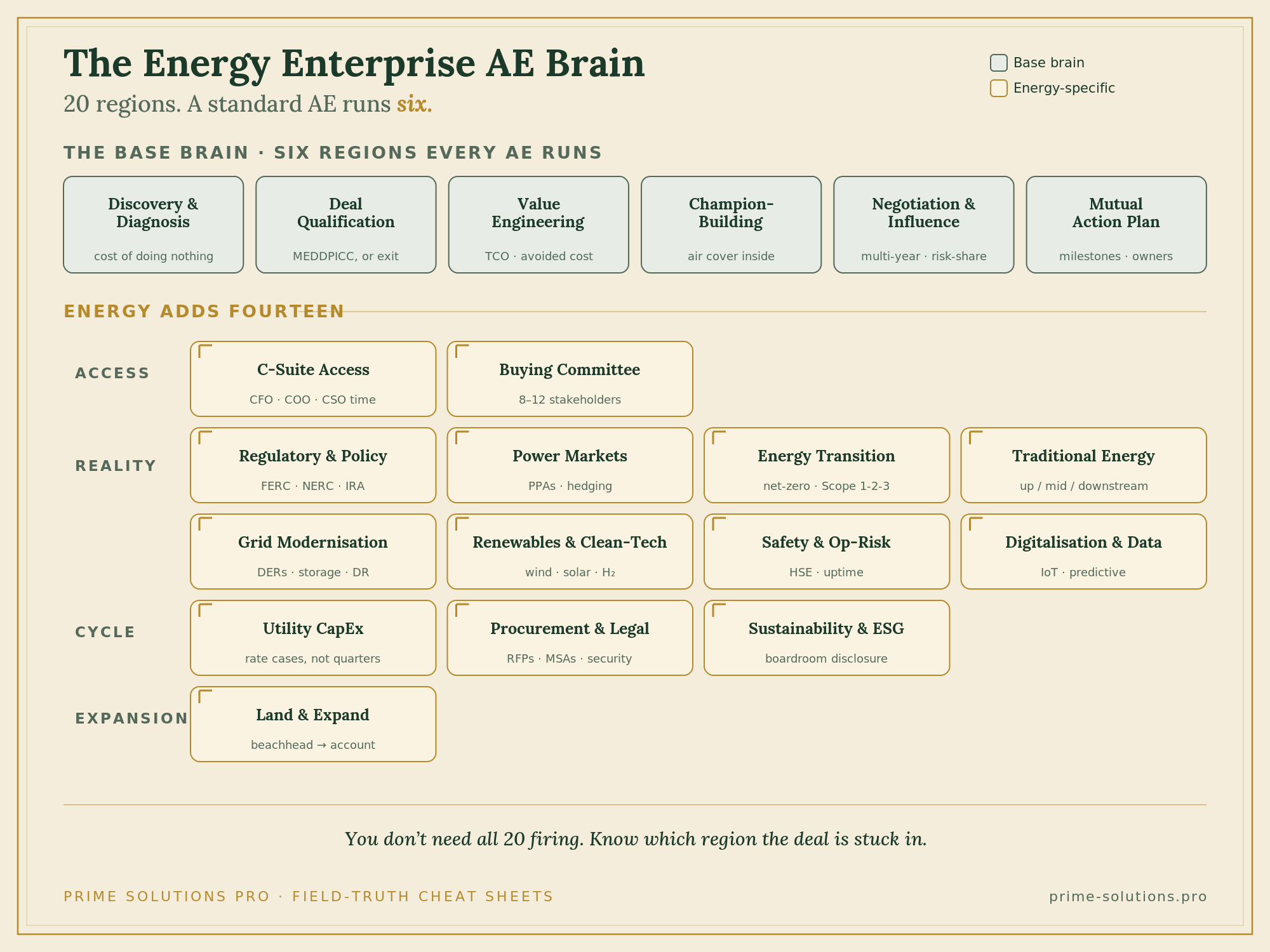
The six regions every good AE already has
A standard enterprise AE comes in well-equipped: discovery and diagnosis; deal qualification; value engineering; champion-building; negotiation and influence; and a mutual action plan. Those six regions win software deals every day.
Drop the same AE into an energy account and the deal stalls. Not because the rep is weak, but because energy does not buy on those six regions alone. It buys on 14 more that most AEs have never had to learn.
In energy, a champion still needs political cover across procurement, HSE, finance, legal, operations, and the C-suite. An ROI model still needs to survive CapEx windows, avoided downtime, rate-case timing, regulatory exposure, and field continuity. The six-region motion is necessary. It is nowhere near sufficient.
1. The access: who you are actually selling to
Energy deals are won at the C-suite level, not in an HR inbox. Eight to twelve stakeholders sit across operations, procurement, sustainability, IT, finance, legal, and the field. You earn time with the CFO, COO, and Chief Sustainability Officer by framing every conversation around margin, resilience, and risk — never features, never cost-per-seat.
Your champion needs the narrative, the numbers, and the political air cover to move the room when you are not in it. A seven-figure exposure should never ride on one relationship. If your champion loses internal standing or changes roles, the deal dies with them unless you have built across the full buying group.
2. The reality: the language you have to speak
This is where generalist motions get exposed. Fluency in energy's domain language is table stakes. Without it you remain a vendor. With it you become an advisor who can co-own the problem.
- Regulatory and policy. FERC, NERC, utility commissions, and the Inflation Reduction Act each shape what energy buyers can approve and when. A seller who cannot speak to regulatory timing cannot explain why a contract structure matters.
- Power markets. Wholesale pricing, power purchase agreements, volatility, and hedging are routine budget considerations. An ROI model that ignores them will not survive CFO review.
- The energy transition. Net-zero targets and Scope 1, 2 and 3 reporting are now procurement criteria at most large energy companies, not just ESG footnotes. Know which scope your solution affects and quantify it.
- Traditional energy. Upstream, midstream, downstream, and legacy assets still run most of the world's energy supply. Sellers who treat these as legacy problems lose the room fast.
- Grid modernization. Distributed energy resources, storage, demand response, and smart controls are active procurement categories, not future-state concepts. Know the difference between a microgrid project and a demand response contract.
- Renewables and clean tech. Wind, solar, battery storage, and hydrogen each carry different deployment realities, permitting timelines, and financing structures. Treating them as interchangeable signals that you have not done the work.
- Safety and operational risk. HSE, uptime, reliability culture, and the cost of unplanned downtime are often the most emotionally weighted topics in the room. Operations leads have seen incidents; they carry that. Speak to risk reduction in concrete terms: hours of avoided downtime, incidents per million hours worked, regulatory penalty exposure.
- Operational technology and data. IoT, predictive maintenance, and operational analytics are reshaping how energy assets are managed. Connect data outputs to operational outcomes, not just dashboard features.
In field employer-of-record work the language gets sharper still: labour codes, reclassification risk, local-content rules, posted-worker exposure, and the HSE liability your people carry the moment they step onto a live site. You cannot de-risk a system you cannot describe.
3. The cycle: how energy actually buys
Energy buyers plan in rate cases and CapEx windows, not quarters. Understanding this is what separates sellers who close from sellers who get strung along.
Procurement cycles in energy are long, RFP-driven, and compliance-heavy. Before a contract executes, a deal typically passes through security reviews, master service agreement negotiation, procurement gate approvals, insurance verification, ESG disclosure requirements, and in some cases board-level sign-off.
Your job is to translate value into a CFO-ready model: total cost of ownership, payback period, avoided cost, and quantified risk reduction. Then co-author a mutual action plan with named milestones, clear owners, specific dates, and documented dependencies. Vague next steps do not survive procurement gates.
Align to their capital cycle, not your quarter. A deal that misses a CapEx approval window can slip a full fiscal year — a slip usually invisible to the seller until it has already happened.
Price gets you into the room. The full 20-region brain is what keeps you there.
4. The expansion: turning one win into an account
Once you have delivered, map the enterprise for expansion: business units, sites, regions, EPC partners, and project phases. A single delivered win gives you legitimate standing to walk that map.
Qualify ruthlessly on the way in. Saying no to a one-hire vanity deal protects your capacity for the account entering three markets next year. One clean win, well delivered, is worth more than five you cannot staff or support.
Go beyond price when structuring the initial deal. Multi-year terms, usage-based models, and risk-sharing clauses align both sides' incentives and protect margin across the life of the relationship. A contract structured only around year-one price is exposed the moment a competitor shows up at renewal. The first contract is a beachhead, not the destination.
What the 20-region model changes
Average deal sizes in complex energy accounts run into eight and nine figures. The margin for a generalist motion is essentially zero at that scale.
You do not need all 20 regions firing on day one. You need to know which part of the deal is actually stuck, then go wire that one. A deal stalling at procurement is a cycle problem. A deal stalling at the C-suite is an access problem. A deal stalling because the buyer does not trust your field delivery is a reality problem — specifically HSE and operational risk.
Sellers who stay in the six-region base motion frame themselves as HR's vendor. Sellers who build across all 20 position themselves as the person keeping financed assets, permits, crews, compliance, and political capital moving. Energy buying runs on 20 regions of knowledge. Most enterprise AEs have only ever built six. Those other 14 are the entire reason energy deals are hard — and the entire reason they are worth winning.
Get the Monday note in your inbox
Published every Monday on LinkedIn. Subscribe there and LinkedIn will deliver each new note straight to your inbox.