
Why MEDDPICC breaks in energy workforce deals
Keep it as your qualification backbone. Then fix the three assumptions energy breaks.
Ayleen Sadvakassova · EOR platform GTM for Energy mandates · 5 October 2026
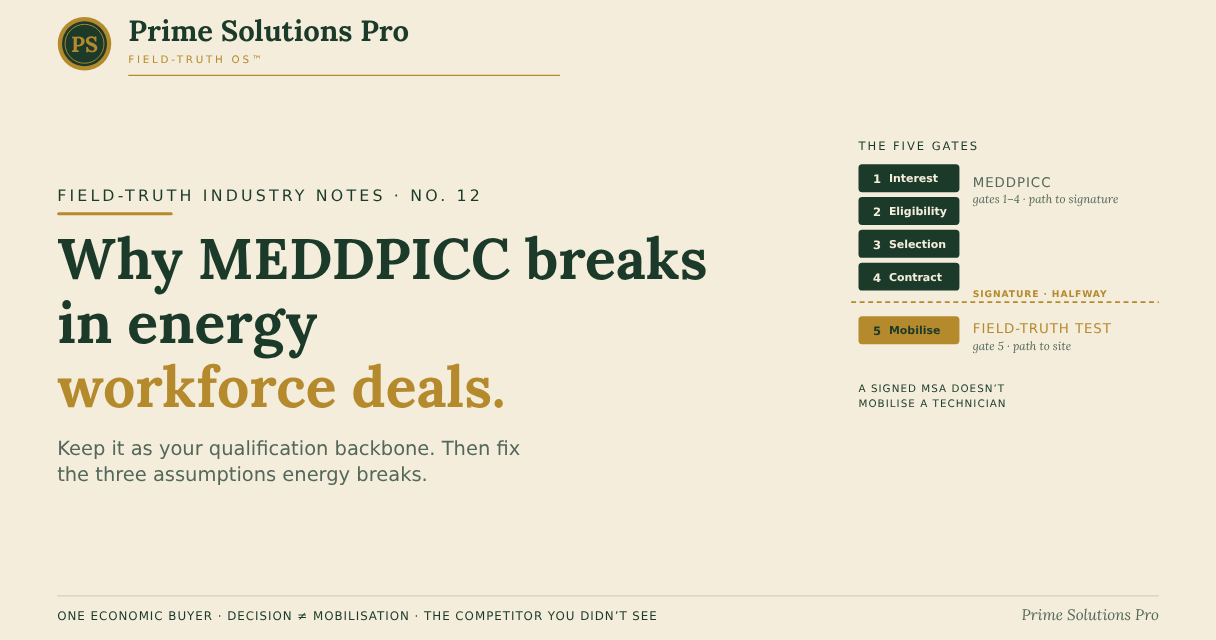
MEDDPICC is the right qualification backbone for most enterprise sales. In energy workforce deals, three of its letters carry assumptions that don't hold. Fix those and you stop losing deals that looked won.
The letter that matters is P
MEDDIC was built at PTC in 1996 by Dick Dunkel, working under John McMahon alongside Jack Napoli (MEDDICC): Metrics, Economic buyer, Decision criteria, Decision process, Identify pain, Champion. MEDDICC adds Competition. MEDDPICC adds Competition and Paper process (Weflow).
Most sellers treat the Paper process field as admin. In energy workforce and EOR deals, it's where healthy-looking pipeline slips.
Decision process asks how the customer chooses a supplier. Paper process asks how, once they've chosen you, the agreement becomes executable.
For an EOR or workforce platform, that track can run through:
- MSA and order-form redlines
- Liability and indemnity caps
- Insurance requirements and certificates
- Vendor onboarding and due diligence
- Data-processing and security reviews
- Tax and permanent-establishment review
- Worker classification and social security
- Site access, HSE and certification checks
- Procurement's approval calendar and signatories
Each one can introduce a new decision-maker, a new risk owner, a request to reprice, or a reason to defer.
Seller lesson: MEDDICC tells you whether the buyer wants to choose you. MEDDPICC tests whether they can contract with you.
Assumption 1: one economic buyer
MEDDPICC is right to ask who can trade budget for outcome. Energy has several centres of gravity.
The operator decides whether you're credible enough to be considered. The EPC or tier-one contractor makes the package and hiring decision. Project controls owns the schedule pressure. Procurement owns the process and the terms. HSE, legal, tax and local content each hold a veto without owning a budget line.
Gartner puts the typical buying group for a complex B2B solution at six to ten decision-makers (Gartner).
On the nine-figure HVDC mandate I won with one of Europe's largest grid operators, 25 people decided the outcome. Eleven could sign. Eight could veto in silence. Six decided whether we'd get repeat work over the eight years. I mapped how I threaded them before the public tender in Note 03, The multithreading system I used to win a 9-figure Energy EOR mandate.
Miller Heiman Strategic Selling earns its place here. The Blue Sheet separates economic, user and technical buyers, plus coaches, and maps what each one needs (Revenue Grid). That's a far closer picture of an energy buying group than one champion and one signature.
Keep the economic buyer on the sheet. Then map everyone around them who can stop the work.
Assumption 2: a decision means you can mobilise
In SaaS, the route looks linear: validate the need, confirm budget, win the evaluation, sign, implement.
In energy, it runs through five gates:
- Gate 1. Commercial interest
- Gate 2. Tender eligibility
- Gate 3. Technical selection
- Gate 4. Contractual acceptance
- Gate 5. Workforce mobilisation
You can be the operations team's preferred supplier and still be unable to deploy. Insurance hasn't cleared. Liability is still in redline. The entity structure, local payroll, social-security registration, immigration or site certification is open. Supplier approval is pending.
A signed MSA doesn't mobilise a technician.
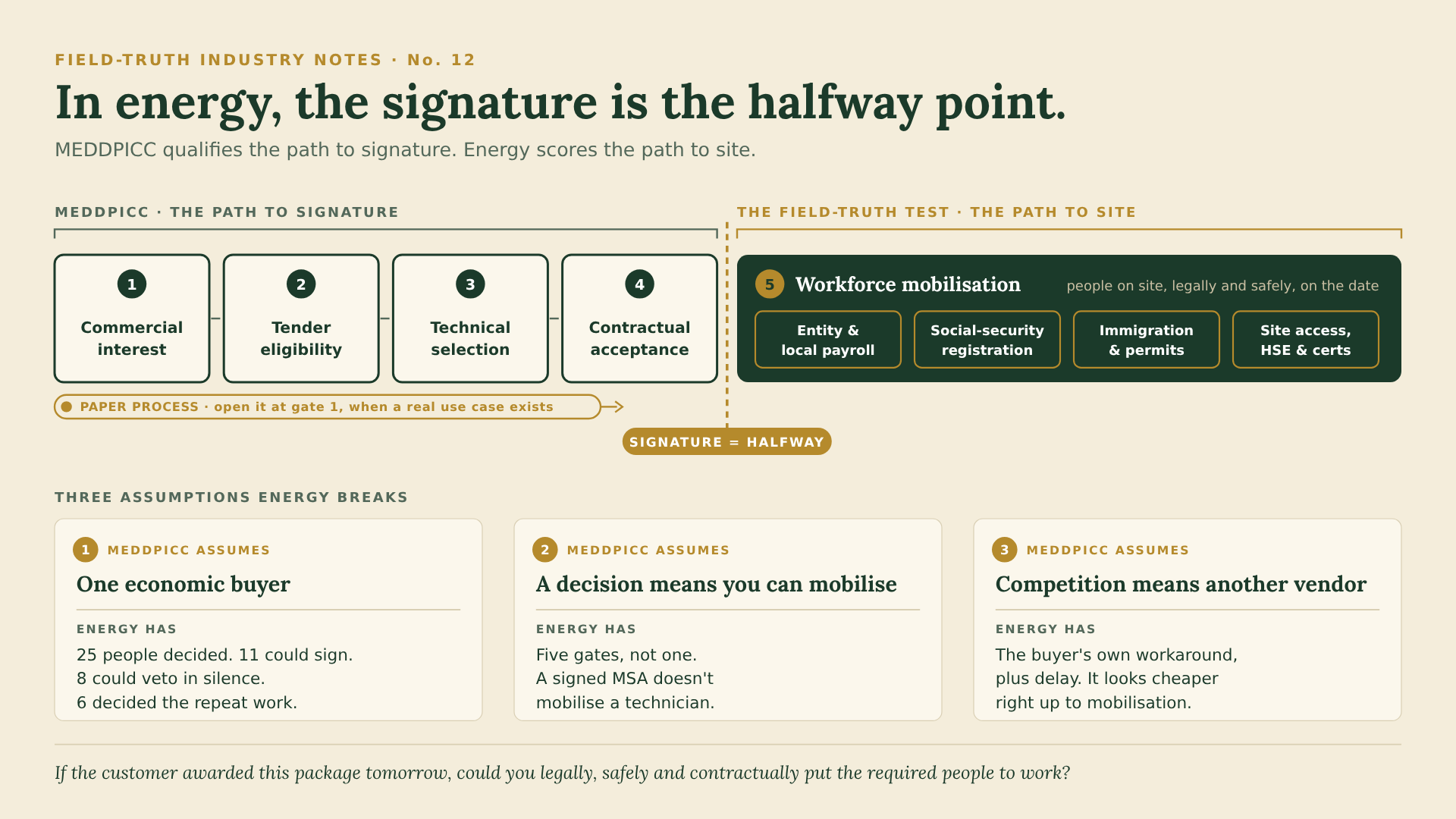
In energy, the signature is the halfway point. The workforce still has to mobilise.
Open the paper process as soon as a real use case exists. Wait for procurement to name a preferred supplier and you've put the slowest track in the deal into the last two weeks of the quarter.
The rules that decide who gets considered vary by jurisdiction and buyer, and they keep moving.
In UK public procurement, the Procurement Act 2023 has governed new procurements in England, Wales and Northern Ireland since 24 February 2025 (GOV.UK). The standard Selection Questionnaire, itself the 2016 replacement for the PQQ, has given way to the Procurement Specific Questionnaire, and each buyer still sets its own conditions of participation on legal, financial and technical capacity (Tussell). Many buyers still say "PQQ".
In UK offshore wind CfD auctions, the Supply Chain Plan that applied through AR6 was replaced in AR7 by the Clean Industry Bonus, which rewards developers for committed supply-chain investment (DESNZ AR7 guidance; Pager Power).
Both shape the shortlist long before anyone signs.
Assumption 3: competition means another vendor
The Competition field stops sellers treating a deal as us against one other vendor. In energy workforce deals, the field is wider:
- The incumbent staffing, payroll or EOR supplier
- A local labour supplier or subcontractor network
- A global consultancy or large MSP
- The EPC's own HR, payroll and legal setup
- A local entity build-out
- A contractor or project-company workaround
- Delay: "we'll solve it after award"
- Doing nothing and absorbing the risk until it's urgent
The most dangerous competitor is often the buyer's own workaround, combined with delay. It looks cheaper right up to mobilisation.
Seller lesson: in energy, a verbal yes is often where procurement starts.
How I layer it
Keep MEDDPICC and build on top of it. Four layers, each with one job.
1. MEDDPICC qualifies deal reality, forecast credibility and the path to signature. It stops false pipeline and late surprises from procurement, legal or a competitor.
2. Miller Heiman Blue Sheet maps the buying group and its politics. It stops the single-champion bet.
3. Shipley-style capture management qualifies the opportunity, runs bid/no-bid, positions you before the RFP and builds win themes. Shipley defines it as "a disciplined approach to qualifying business opportunities and developing a win strategy" (Shipley Associates). It stops you starting strategy on the day the tender is published.
4. The Field-Truth energy layer proves you can deliver on this project, in these countries, on this package. It stops you selling a global capability claim that fails at site level.
Capture is the bridge most enterprise AEs are missing. MEDDPICC asks whether the opportunity is real. Capture management asks whether you can shape it and win it. Most of the room is gone by the time the RFP lands, which I covered in Note 10, You don't answer the RFP. You win it before it's written.
Five tests for every energy deal
1. Contracting. Which entity contracts, which one employs, and where does the risk sit? Evidence: contract map, entity map, first legal and tax read.
2. Workforce. Which roles, certificates, rotations, languages and mobilisation dates are fixed? Evidence: role matrix, certification matrix, mobilisation plan.
3. Country. What are the local employment, payroll, immigration, tax, social-security and local-content rules? Evidence: country compliance matrix, named local partners, assumptions log.
4. Tender. Direct buy, framework call-off, PSQ or PQQ, ITT or multi-stage? What's scored, and what's only claimed? Evidence: evaluation map, compliance matrix, bid calendar.
5. Delivery. What has to happen for a person to be on site, legally and safely, on the required date? Evidence: critical path, risk register, owners and decision deadlines.
This is where the 150-country slide runs out of road. A broad footprint helps with supplier consolidation and future expansion. The tender scores the countries, roles, certificates, insurance and mobilisation dates on this project.
The one question that qualifies an energy deal
If the customer awarded this package tomorrow, could you legally, safely and contractually put the required people to work?
If the answer's unclear, pull the deal out of late stage. It hasn't been qualified yet.
MEDDPICC earns its place because the paper process decides whether a deal becomes revenue. In energy, the signature is the halfway point. The workforce still has to mobilise.
Which of the three has cost you an energy deal: the single economic buyer, the gap between decision and mobilisation, or the competitor you didn't see?
Tell me where your energy deal is stuck, and I'll reply with the one test from this note I'd run first.
Sources
- MEDDICC, Who created MEDDIC?
- Weflow, MEDDPICC
- Gartner, The B2B buying journey
- Revenue Grid, Miller Heiman sales process guide
- GOV.UK, Transforming public procurement
- Tussell, The Procurement Specific Questionnaire, explained
- DESNZ, Supply Chain Plan guidance: Allocation Round 7
- Pager Power, The Clean Industry Bonus
- Shipley Associates, Capture management
Get the Monday note in your inbox
Published every Monday on LinkedIn. Subscribe there and LinkedIn will deliver each new note straight to your inbox.