
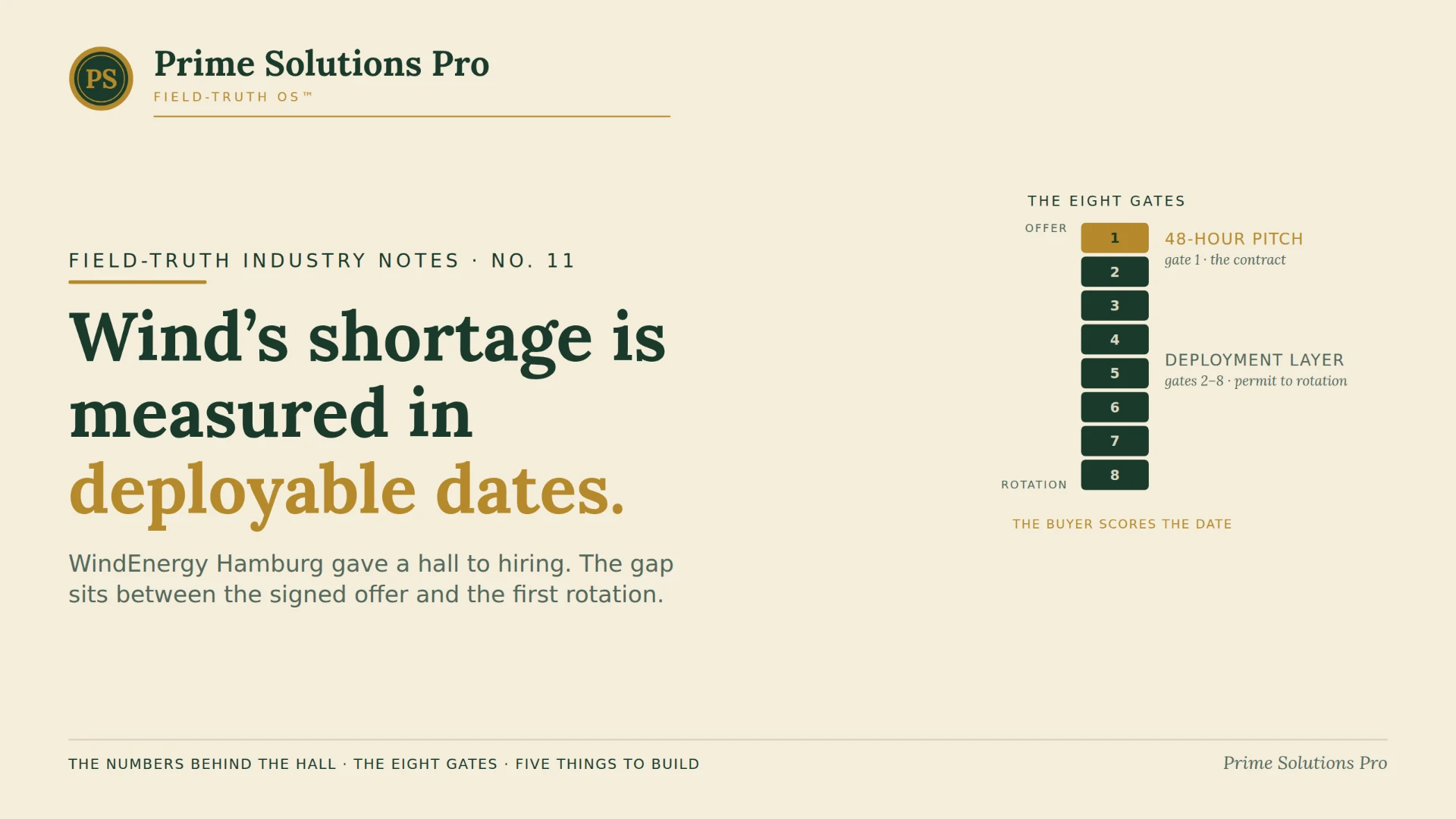
Wind's shortage is measured in deployable dates
WindEnergy Hamburg gave a hall to hiring. The gap EOR platforms can own sits between the signed offer and the first rotation.
Ayleen Sadvakassova · EOR platform GTM for Energy mandates · 28 September 2026
Last week, Hall B3 at WindEnergy Hamburg belonged to recruiting. Two Recruiting Days on 24 and 25 September. A Recruiting Forum stage. A Career Happy Hour. Free passes for students and apprentices. A Job Route that matched companies and candidates on skills rather than job titles. Around 43,000 participants from more than 1,600 companies and 40 countries were expected across the four days.
When a trade fair that size hands a hall to hiring, the shortage has left the HR department.
The numbers behind the hall
WindEurope has put figures on it. Its workforce report maps 235 job profiles across the wind lifecycle and names the sharpest shortages by 2030: about 7,000 blade technicians, 6,500 field engineers and 5,000 pre-assembly technicians. Eight of the ten critical roles run through vocational training.
In June, WindEurope launched a Workforce Development Tool that forecasts demand by country, project phase and job family. At WindEurope in Madrid, GWO's panel put mutual recognition of certifications and cross-border mobility across Europe on the table.
Every one of those figures counts people the industry has to find. The step where I've watched projects lose time for two decades comes after that: turning a qualified person into one who can legally stand on a specific site, in a specific country, on a specific date.
That step is where SaaS EOR platforms can win energy. Most of them are still selling the step before it.
Hired is a status. Deployable is a date.
A project director wants one thing from a signed offer: the date this person clears every gate between the offer and the vessel.
The gates look like this. Employment in the country of work. Work authorisation. The GWO modules the site requires. A valid offshore medical. BOSIET or its local equivalent. The client's induction and approval. The local-content position that lets the permit be processed at all. A rotation the local labour rules will accept.
Each gate has its own owner, its own lead time and its own expiry date. Miss one and the others stop mattering.
No valid medical? No offshore transfer. No offshore transfer? No technician at the turbine. No technician at the turbine? The commissioning window slips while the vessel's day rate keeps running.
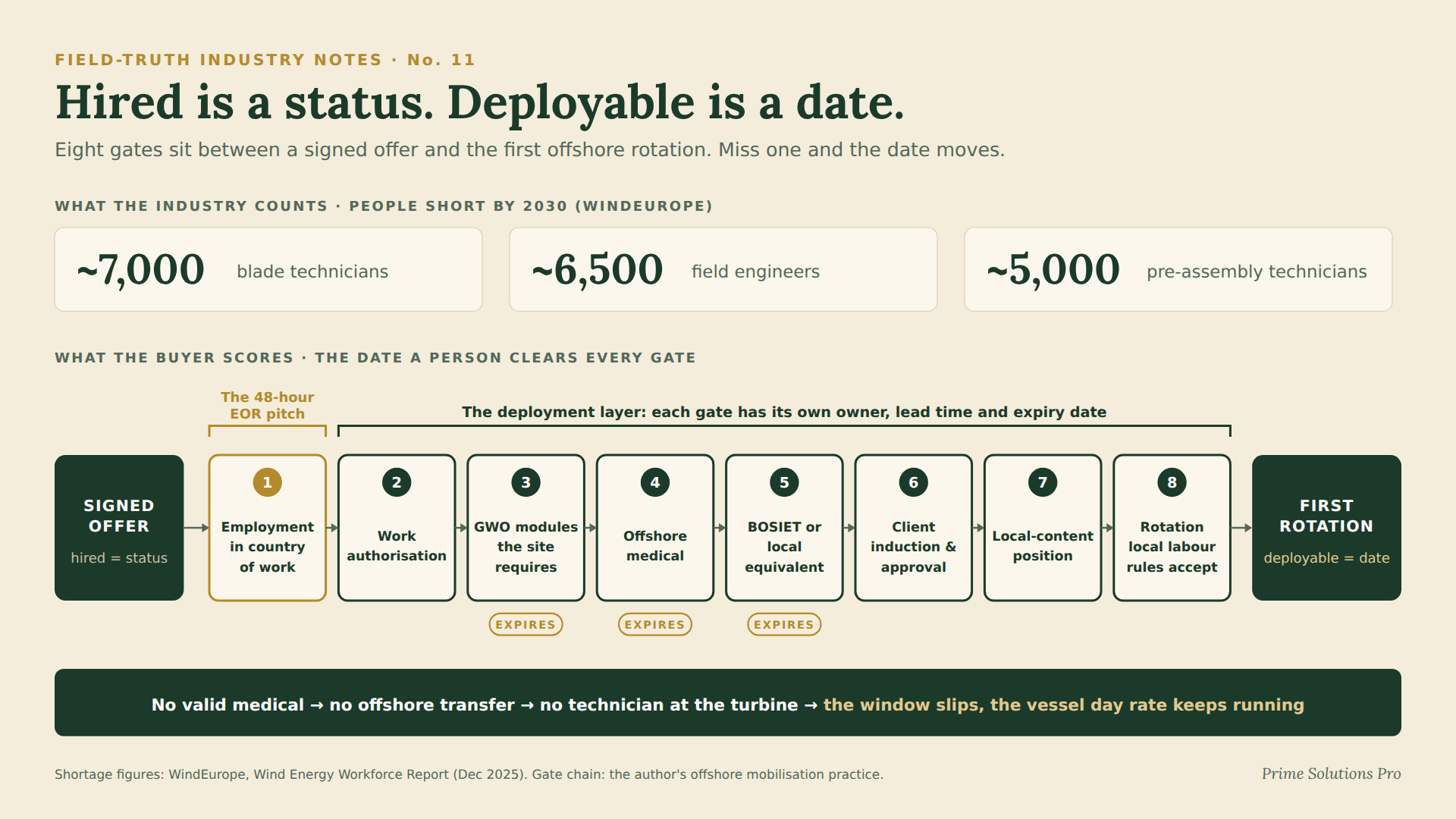
The buyer scores that chain. This note extends Note 08, The real bottleneck in 2026 data centre and fab builds is not capital, where the constraint was the finite pool of cleared, certified, legally employed people. Wind is the same argument at sea, with a weather window attached.
Seller lesson: your buyer is purchasing a deployable date. Put the date in the proposal.
What deployment looked like in Taiwan
In 2019, a near-1GW offshore wind programme in Taiwan needed an offshore workforce the local market didn't have yet. Some GWO modules weren't available in Taiwan. BOSIET routes were limited. The staffing company I represented had no prior developer relationship anywhere in the world.
Finding candidates was the smaller half of the job. I sourced people with the aptitude the work demands, including military leavers and high-rise window cleaners.
Then the real work started. I routed them through Thailand and Malaysia for the modules Taiwan couldn't deliver. I took 14/14 offshore rotations for an onshore-based operations team through two appeal processes with the Taiwan government.
The result was an exclusive three-year scope to attract, train, certify and retain 14 offshore technicians, every one GWO and OGUK compliant.
Then COVID closed Taiwan's borders. More than twenty of the programme's workforce service providers declared mobilisation impossible. We mobilised a 20+ person expatriate team for offshore substation commissioning under pandemic restrictions, using Advance Approval protocols worked out in parallel with regulators and Chamber of Commerce coalitions. The client later moved consultants from other agencies under my coordination.
Every piece of that work was deployment: certification routes, permits, rotation approvals, border exemptions. The Recruiting Forum in Hamburg was pitched at career starters and professionals looking for a new challenge. Those people are the supply. The route that makes them deployable is the product.
Seller lesson: the provider who shortens the path to site keeps the work.
Why the 48-hour pitch misses the buyer
Generalist EOR platforms sell speed. Onboard someone compliantly in 48 hours, in 150 countries, from one dashboard. That speed is real, and it runs on the wrong clock for a wind project. The employment contract is usually the shortest gate in the chain.
A wind buyer is scoring whether you can put the right people into the two or three countries that decide COD (commercial operation date), under the local-content rules there, with the credentials the site requires, before the installation window closes.
So spare me the "150 countries" slide. The buyer is reading three of them.
In Note 02, Why generalist EORs lose to energy specialists (and what changes in 2027), I argued that platforms win on speed, specialists win on field expertise, and the two are converging. Hamburg shows where they meet: the deployment layer.
Five things I'd build if I ran product at an EOR platform chasing wind
1. A deployable date on every worker record. Per person, per project, show the date they clear every gate: contract, permit, medical, GWO modules, client induction, rotation approval. Make it the number your sales team quotes in the tender. "Onboarded" answers HR's question. The deployable date answers the project director's.
2. Credentials inside the employment record, tracked against the rotation. GWO modules, offshore medicals and BOSIET all expire. On an offshore programme the risk sits in the rotation that falls after the expiry date, which a calendar reminder won't catch. Tie expiry alerts to the rotation plan and the client's approved list. I held 100% GWO and OGUK medical compliance across a mobile offshore workforce. Buyers can't get that discipline from a generic dashboard, so build it in.
3. Conversion routes for career switchers. The scarce supply will come from oil and gas, maritime, construction, defence and electrical contracting. Map the shortest compliant route from those trades to a wind site: which modules are missing, where they can be delivered, how long it takes, who pays, and who employs the person while they train. I did this by hand in Taiwan, through Thailand and Malaysia. A platform can run it as a workflow and own part of the supply.
4. Headcount planned from the project schedule. WindEurope now forecasts by country, phase and job family. Buyers will expect the same resolution from their workforce partner. Turn installation, commissioning and O&M milestones into roles, start dates, rotations and the permit lead time for each country. Then price the mobilisation and the risk you carry, which is the case I made in Note 05, Why per-seat pricing loses energy workforce tenders.
5. A partner for the gates you can't own yet. No platform will build certification routes, offshore medical coverage and client approvals in every market in one year. Say so in the tender. "Through a partner, with an SLA" scores better than a soft yes. The specialists already run this layer. The platforms have the rails.
Seller lesson: a platform that can quote the deployable date gets scored on risk. A platform that quotes onboarding time gets lined up on seat price.
Where I'd start next quarter
Skip the five-feature roadmap. Pick one job family from WindEurope's shortage list, blade technicians or field engineers. Pick one country corridor where you already employ people. Find one live trigger with a date on it: an EPC (engineering, procurement and construction) package release or a commissioning ramp-up.
Then quote a deployable date for a named crew, gate by gate, and watch how the buyer's questions change.
If you run product or sales at an EOR platform: which gate in that chain do you own today, and which one does your buyer think you own?
Tell me which country and job family you're looking at. I'll reply with the gates I'd expect to decide the date there.
Get the Monday note in your inbox
Published every Monday on LinkedIn. Subscribe there and LinkedIn will deliver each new note straight to your inbox.